Restaurant inventory management software for the UAE: stock deducted by recipe at every sale, counts that show what went missing, waste priced in AED.
Most restaurants find out what went missing at the end of the month, when the supplier bill lands and the numbers do not add up. foodash is restaurant inventory management software for the UAE that works the other way round: stock comes off the shelf the moment a dish is sent to the kitchen, every count is checked against what should be there, and the gap has a name and a price the next morning.
AED 300
a month on the annual plan, stock management included
2 days
free trial of the full product, no card
0%
of your sales taken, on any plan, ever
A spreadsheet tells you what you had. Inventory software should tell you what happened to it.
Restaurant inventory management software in the UAE that counts at the sale
Every menu item carries its recipe. When the order is sent for preparation, foodash takes those quantities off stock on its own: the chicken, the rice, the sauce, the box it leaves in. Nobody types anything in at the end of the night, and nothing is deducted twice if the order is edited or sent again.
- Extras and swaps count too. An extra shot adds its coffee, and oat milk instead of milk takes oat milk off the shelf, not milk.
- Units are converted for you. Buy rice by the kilo and use it by the gram, buy cream by the litre and pour it by the millilitre, or count chicken by the piece at 200 grams each.
- A voided order gives back exactly what it took, no more and no less.
- Stock never shows a negative number. If the kitchen sells more than the shelf says it has, foodash records it as a case for you to look at, instead of quietly going below zero.
- The POS warns the cashier when an ingredient behind an item is low or out, and still takes the order, because refusing money at the rush is worse than a warning.
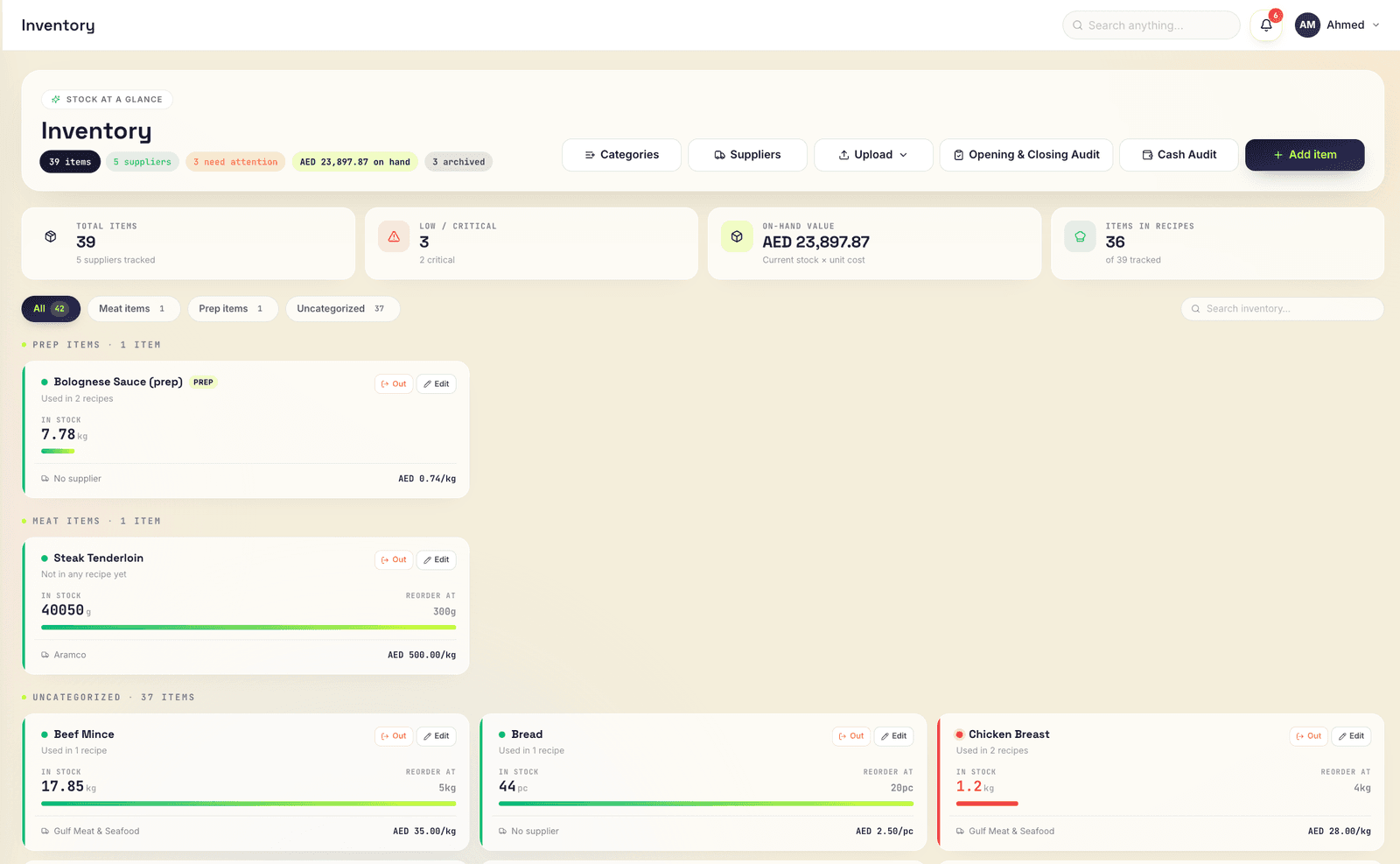
Counts that show what went missing
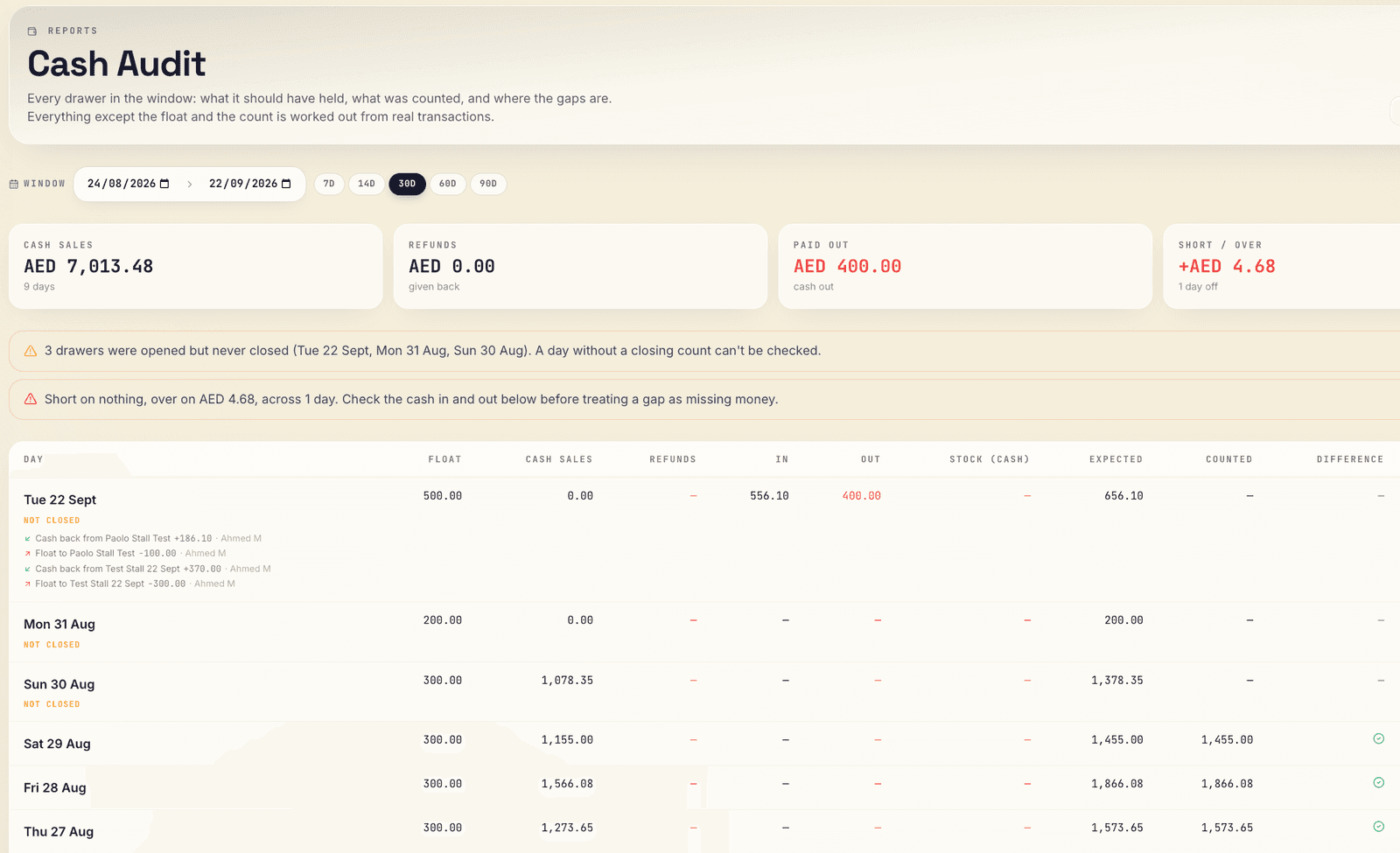
You choose when your team counts: an opening count, a closing count, or both, daily, weekly, twice a month or monthly. Items you never want skipped can be marked to be counted every time. A count taken on a day the schedule did not ask for still updates the shelf, but it cannot replace the official one, so nobody gets to pick which count the report uses.
foodash then works out what should have been there, from purchases, sales, waste, stock written off and voids, and sets it beside what was counted. The difference is shown by item, by day, week or month, in dirhams as well as units. When something does not add up, you can send the person who counted a link to explain it, no login needed, and paste it into WhatsApp.
Waste, written down with a reason and a price
Expired, damaged, spilled, dropped, over prepared: each piece of waste is logged with its reason and who logged it, and foodash prices it in dirhams from what you paid for it. The reports show waste by reason, so you can see whether the problem is ordering too much or a careless shift, and the monthly report puts waste into your food cost instead of leaving it out.
From a low stock line to a supplier's confirmation
Each item has a low level and a critical level, set in whatever unit you think in. Anything below them is counted on your dashboard and flagged in your notifications. When you start a purchase order, the Reorder agent suggests quantities for that supplier from what you actually used over the last week and the last four weeks, aims for about a week of cover, rounds to whole packs, and tells you why for every line.
Send the order by email, download it as a PDF, or open it in your own WhatsApp with a link the supplier taps to confirm or decline. When the delivery arrives, log it against the order, attach a photo of the receipt, or let foodash read the invoice photo for you. If what arrived is not what you ordered, it is flagged.
Every night, an agent reads the numbers
The Inventory agent runs after close on the previous business day. It looks for the things an owner would look for if there were time: a closing count that came up short, a count that was never done, stock that dropped with no sale, waste that has become the biggest line, a delivery that did not match its order. What it finds lands in one inbox, in plain words, waiting for you in the morning.
What each dish really costs you
Because recipes and ingredient costs live in the same place, every menu item shows its recipe cost, the profit on each sale and its margin, at today's prices. When a supplier puts a price up, you see which dishes it hurts. And stock bought with cash from the drawer is taken off what the drawer should hold, so the cash count and the stock count tell the same story.
What it costs
| Plan | Per month | Paid |
|---|---|---|
| Monthly | AED 400 | Every month |
| 6 months | AED 349 | AED 2,094 once |
| 1 year | AED 300 | AED 3,600 once |
Recipes, stock, counts, waste, suppliers and purchase orders are all in the base price, and the Inventory agent runs on the AI credits every restaurant gets each month. Extra users are AED 50 each a month. There is no setup fee and no cut of your sales. Prices are before 5% VAT, and each branch is its own subscription.
What foodash does not do yet
- No barcode scanning, no expiry dates or batch numbers, and no connected scales. Stock is counted by hand.
- No stock transfers between branches. Each branch keeps its own stock.
- Low stock shows on your dashboard and in your notifications, not as an instant message to your phone.
- No delivery app integration. Talabat, Careem and Deliveroo orders are entered like any other order, and their stock comes off the same way.
Questions owners ask about inventory software
How do restaurants keep track of inventory?
The reliable way is to link every menu item to its recipe so each sale deducts its ingredients, then count on a fixed schedule and compare the count with what should be there. foodash does the deducting and the comparing; your team only does the counting.
How often should a restaurant count its stock?
Count the items that cost you most every day, and the rest weekly. In foodash you set the schedule once, daily, weekly, twice a month or monthly, and mark the expensive items to be counted every time.
Does foodash deduct stock automatically when I sell?
Yes. When an order is sent for preparation, each item's recipe comes off stock, including extras and swaps, and a voided order puts back exactly what it took.
Can I see the food cost of each dish?
Yes. Every menu item shows its recipe cost, profit per sale and margin at current ingredient prices, and the monthly report shows food cost against revenue.
Can my suppliers confirm orders on WhatsApp?
Yes. You send the purchase order from your own WhatsApp with a link, and the supplier taps it to confirm or decline, no account needed. Email and PDF work too.
Is inventory an extra charge?
No. Stock, recipes, counts, waste, suppliers and purchase orders are in the base price: AED 400 a month, or AED 300 a month on the annual plan, before VAT.
See foodash on your own menu.
Start a 2-day free trial: full product, no card required.